
Strategic AI adoption — across design, documentation, and workforce — is becoming the defining operational differentiator in project delivery.
The Gap Between Interest and Impact
Artificial intelligence has moved from novelty to necessity in the language of AECO leadership. Virtually every firm of scale is exploring AI in some form — from generative design tools to document review automation to predictive scheduling. Yet for all the conversation, most organizations have yet to see meaningful operational returns. The technology is present; the transformation is not.
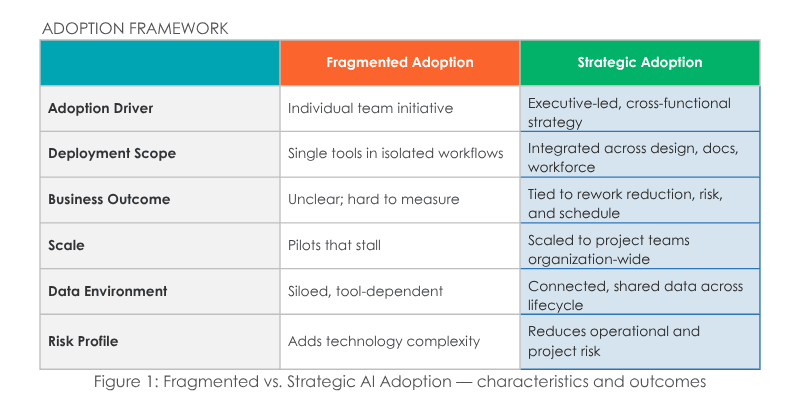
The reason is not a failure of tools. It is a failure of strategy. Firms that are experimenting with AI in isolated pockets — one team testing a workflow assistant, another running a pilot on clash detection — are accumulating technology without building capability. Fragmented adoption, by its nature, produces fragmented results.
The AECO firms that will define best practice over the next five years are not those with the largest portfolio of AI subscriptions. They are the ones deploying AI deliberately, across integrated layers of project delivery, to solve operational problems that matter.
The Cost of Fragmented Adoption
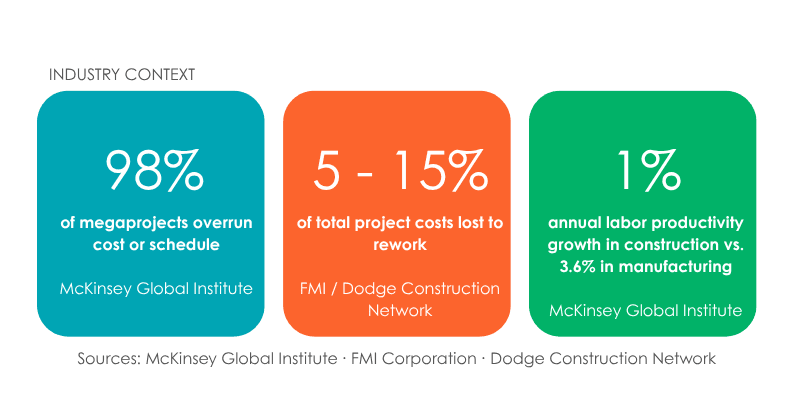
The construction industry has a well-documented productivity problem. McKinsey research has consistently identified construction as one of the least digitally mature sectors of the global economy, with large projects routinely exceeding budgets and timelines. FMI research points to an industry where significant portions of working time are spent on non-value-adding activities — searching for information, resolving miscommunication, managing rework.
Against that backdrop, the appeal of AI is obvious. But the way most firms are deploying it amplifies an existing structural challenge: siloed operations. When individual teams adopt tools independently, without integration into broader workflows or shared data environments, AI becomes yet another layer of technology to manage.
Without executive sponsorship and a clear deployment framework, AI pilots stall. They demonstrate local utility without producing organizational advantage. The business case never fully materializes, and the technology gets filed alongside previous waves of tools that promised more than they delivered.
"The firms that will see real results are those implementing AI strategically to solve real operational problems across the project lifecycle."
Where AI Is Delivering Real Value Across the Project Lifecycle
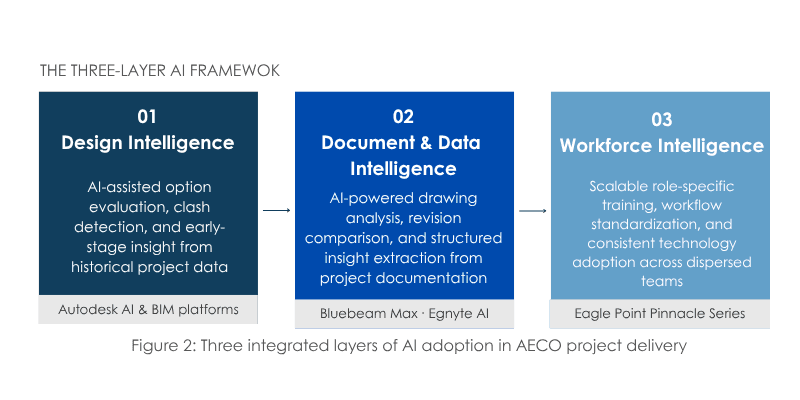
The most operationally effective firms are deploying AI across three distinct but interconnected layers of project delivery. Each addresses a specific category of operational friction. Together, they create the conditions for compounding returns.
Layer One: Design Intelligence
The earliest phases of a project carry the greatest opportunity — and the greatest risk. Decisions made at the design stage have outsized consequences for cost, constructability, and schedule. Yet those decisions are typically made under conditions of incomplete information and intense time pressure.
AI is beginning to change that dynamic. Platforms integrating AI into design workflows — Autodesk's suite, for instance, has been progressively embedding AI capabilities across design and coordination tools — are enabling teams to evaluate more options earlier, identify clashes before they become field problems, and surface insights from historical project data that would otherwise remain inaccessible.
The strategic value is not automation for its own sake. It is the ability to make better-informed decisions faster, at the stage where those decisions have the greatest impact on project outcomes.
Layer Two: Document and Data Intelligence
Construction is a documentation-intensive industry. A major infrastructure project can generate hundreds of thousands of drawings, submittals, RFIs, specifications, and revision histories across its lifecycle. Managing that volume — and extracting reliable insight from it — has historically been a manual, time-consuming process with significant margin for error.
AI-assisted document analysis is beginning to address that challenge directly. Tools such as Bluebeam Max, which introduces AI-assisted drawing analysis and comparison, are enabling project teams to work through document sets more efficiently and catch discrepancies earlier. Platforms like Egnyte AI are helping firms extract structured insights from unstructured project data — transforming a historically opaque information environment into a searchable, analyzable asset.
For owners and contractors managing complex project portfolios, the ability to systematically analyze and cross-reference documentation has direct implications for rework rates, claim management, and schedule performance. AI-assisted document intelligence is one of the most direct levers available to reduce that exposure.
Layer Three: Workforce Intelligence
Technology adoption in AECO has a long history of underperformance — not because the tools are deficient, but because the workforce is not equipped to use them consistently and at scale. Training programs that run at implementation and never repeat, workflows that vary by project team, and knowledge gaps that widen as experienced staff transition out: these are among the most consequential and least-discussed operational risks in the industry.
AI-enabled workforce platforms are beginning to close that gap. Eagle Point's Pinnacle Series, for example, provides organizations with a structured platform for delivering role-specific training, standardizing workflows, and scaling technology adoption across dispersed project teams.
Workforce intelligence is the enabling layer. Design intelligence and document intelligence depend on it. Firms that invest in structured, scalable knowledge management alongside tool deployment are building organizational capability — not just a technology stack.
AI Across the Full Project Lifecycle
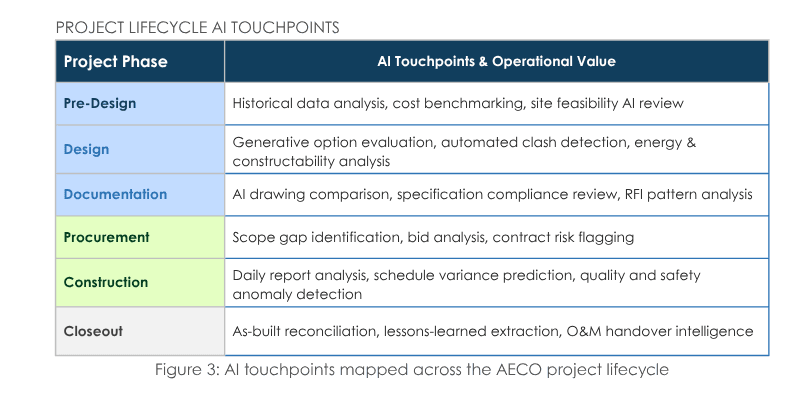
The following framework illustrates where AI intervention creates the most significant operational value at each stage of project delivery:
The Emerging Model: AI as Connected Infrastructure
The distinction between firms that see marginal AI returns and those that see transformative ones increasingly comes down to connectivity. AI tools deployed in isolation produce local efficiency. AI deployed across design, documentation, and workforce as an integrated operational framework produces systemic advantage.
Consider the project lifecycle as a chain of decisions and dependencies. Design decisions shape documentation requirements. Documentation quality shapes field execution. Field execution reflects workforce capability. When AI supports each of these dimensions — and when those dimensions share data and inform each other — the cumulative effect on project performance is substantially greater than the sum of individual tool deployments.
The World Economic Forum and others tracking construction productivity have noted that firms achieving consistent performance improvement are characterized not by technology volume, but by integration depth.
What AECO Executives Should Prioritize
For senior leaders navigating AI investment decisions, three priorities are worth anchoring to:
1. Identify high-friction workflows as deployment targets. AI produces the most defensible returns when applied to workflows where teams currently spend significant time interpreting, analyzing, or reconciling information. Document review, drawing comparison, specification compliance, and training delivery are all candidate areas. Start with the workflows that consume the most time with the least leverage.
2. Anchor deployment decisions to risk reduction, not efficiency alone. Efficiency gains are real and measurable, but the more compelling case for AI in AECO is risk mitigation. Catching a design conflict before it becomes a field issue, identifying a document discrepancy before it triggers a claim, ensuring a project team has the training to execute a new workflow correctly — these outcomes have financial consequences that dwarf the cost of the tools that produce them.
3. Scale tools that demonstrate measurable organizational outcomes. Piloting is a necessary first step. It should not be a permanent posture. Firms that move from pilot to scale are those with clear outcome metrics established at the outset — and executive accountability for ensuring that tools that work get deployed broadly.
The Defining Question
The future of AI in AECO will not be determined by which firms adopt the most tools. It will be determined by which firms integrate AI most effectively into the workflows that define project delivery — design decisions, documentation integrity, and workforce capability.
The industry's productivity challenges are structural and persistent. They are not solved by technology alone. But they are increasingly being addressed by firms that recognize AI as a practical operational capability rather than a competitive signal — and that are building the strategy, infrastructure, and organizational discipline to deploy it with intention.
"The window for early-mover advantage is narrowing. The firms that move from experimentation to integration now will be operating at a fundamentally different performance level within the decade."
The question for executive leadership is not whether to invest in AI. It is whether the investment is being made strategically enough to matter.
Referenced Industry Research
- Autodesk, State of Design & Make Report (annual) — industry benchmarks on technology adoption and project performance across AEC sectors
- McKinsey Global Institute, Reinventing Construction: A Route to Higher Productivity — construction productivity gaps and the role of digital technology
- FMI Corporation, Construction Industry Research — workforce, operational efficiency, and technology adoption trends in US construction
- Dodge Construction Network, SmartMarket Reports — digital tool adoption, BIM utilization, and technology investment patterns in AECO
- World Economic Forum, Shaping the Future of Construction — global construction productivity analysis and digital transformation frameworks